
Lebanon County Arrest Records and Court Charges
Lebanon County arrest records begin on the law-enforcement or custody side. They may involve the arresting agency, booking activity, custody status, bail, or jail administration. The Lebanon County Correctional Facility page gives facility information, but no official county jail roster was located in the research. For custody status, use official jail, VINE, DOC, or court routes rather than assuming there is a county mugshot database.
Court charges after arrest begin when a complaint, citation, or information places alleged offenses into the court system. The District Attorney decides and prosecutes charges in Common Pleas criminal cases. The resulting court charge record can show statute number, grade, offense description, offense date, OTN, complaint or citation number, arresting agency, issuing authority, lower-court disposition, information filed, amendments, pleas, and final disposition. The full case file and outcome are handled on the Lebanon County criminal court records page.
Find Lebanon County Arrest Records and Charges
Use UJS Case Search for public charge rows on criminal, MDJ, and traffic dockets. Search by defendant name, docket number, OTN, complaint number, citation number, or incident number, then narrow to Lebanon County or Judicial District 52. The charge section of a docket should be read with the disposition section because charges may be changed or resolved count by count.
- Start with UJS Case Search and choose Participant Name, Docket Number, OTN, Complaint Number, or Citation Number.
- Filter to Lebanon County or Lebanon - 52 where the portal allows it.
- Open the docket sheet and find the charge rows, statute numbers, grades, offense dates, and OTN.
- Check the disposition and sentence sections before treating any charge as a conviction.
- For custody or booking information not found online, contact LCCF, VINE, or the relevant law-enforcement record custodian.
The image from the Pennsylvania Office of Open Records reflects the agency-record route for some non-case arrest or administrative records.
Right-to-Know requests can help with agency records, but court case charges are primarily found through court access rules and docket searches.
Charges After Arrest in Lebanon County
Charging documents explain how an arrest or police allegation becomes a court matter. Pennsylvania dockets commonly show complaints and citations at the lower-court level, then an information filed by the Commonwealth after a case is bound for Common Pleas. The research did not identify a local indictment process as the routine Lebanon County path, so indictment should not be assumed for ordinary county cases.
| Document | Who Files It | What It Starts or Shows |
|---|---|---|
| Complaint | Police or prosecution process | Initial criminal allegations, complaint date, arresting officer, issuing authority, incident number, and charge rows. |
| Citation | Law enforcement officer | Traffic or summary offense case, often with citation number and MDJ docket activity. |
| Information | Commonwealth / District Attorney | Formal Common Pleas charging document after lower-court proceedings send charges forward. |
The image from Pennsylvania Right-to-Know Law background shows the public-record law route that may apply to agency records outside the court docket.
For filed court charges, the docket and Clerk of Courts usually matter more than RTKL because case records have their own access policy.
Lebanon County Charge Status
Charge status can change as a case moves from arrest to preliminary hearing, Common Pleas filing, plea, trial, disposition, and sentencing. A docket may show an original charge and later show that the charge was amended, reduced, dismissed, waived for court, or resolved by plea or verdict. Always read the final disposition by count.
| Status | What It Means |
|---|---|
| Pending | The charge is still active or awaiting a later court event. |
| Waived for court | A lower-court disposition sending charges to Common Pleas. |
| Amended or reduced | The statute, grade, or charge description changed before final disposition. |
| Dismissed | The charge ended without a conviction on that count. |
| Guilty plea or verdict | The charge resulted in a conviction and may have a sentence entry. |
Lebanon County Charges vs Convictions
Charges after arrest are accusations. Convictions are final outcomes after a guilty plea or guilty verdict. One arrest can produce several charge rows, and each row may resolve in a different way. A docket can show dismissed charges next to convictions, so the disposition and sentence fields are essential.
| Charge | Conviction | |
|---|---|---|
| Meaning | An alleged offense filed by complaint, citation, or information. | A final guilty plea or verdict on a count. |
| Record fields | Statute, grade, offense date, OTN, complaint or citation number. | Disposition date, sentence, judge, sentence type, conditions, costs, fines, or restitution. |
| Risk of misreading | May be dismissed, reduced, or amended later. | Should still be checked for appeal, sealing, expungement, or limited access. |
Sealed and Expunged Charge Records
Lebanon County charge records may be restricted by juvenile law, a court order, Pennsylvania limited access, Clean Slate rules, or expungement. The Clerk of Courts links an expungement procedure, and UJS materials explain that limited access removes qualifying records from public view while criminal justice agencies keep access. Expungement is a different remedy for eligible records.
| Limited Access / Sealed | Expunged | |
|---|---|---|
| Public result | Qualifying records are hidden from public searches. | Eligible records are removed or destroyed from public access. |
| Agency result | Courts and criminal justice agencies may still see records. | Access depends on the expungement order and state law. |
| Local step | Check UJS, docket status, and Clerk of Courts instructions. | File the proper petition and wait for court action before relying on removal. |
The image from Pennsylvania limited-access and expungement information supports the distinction between public sealing and expungement.
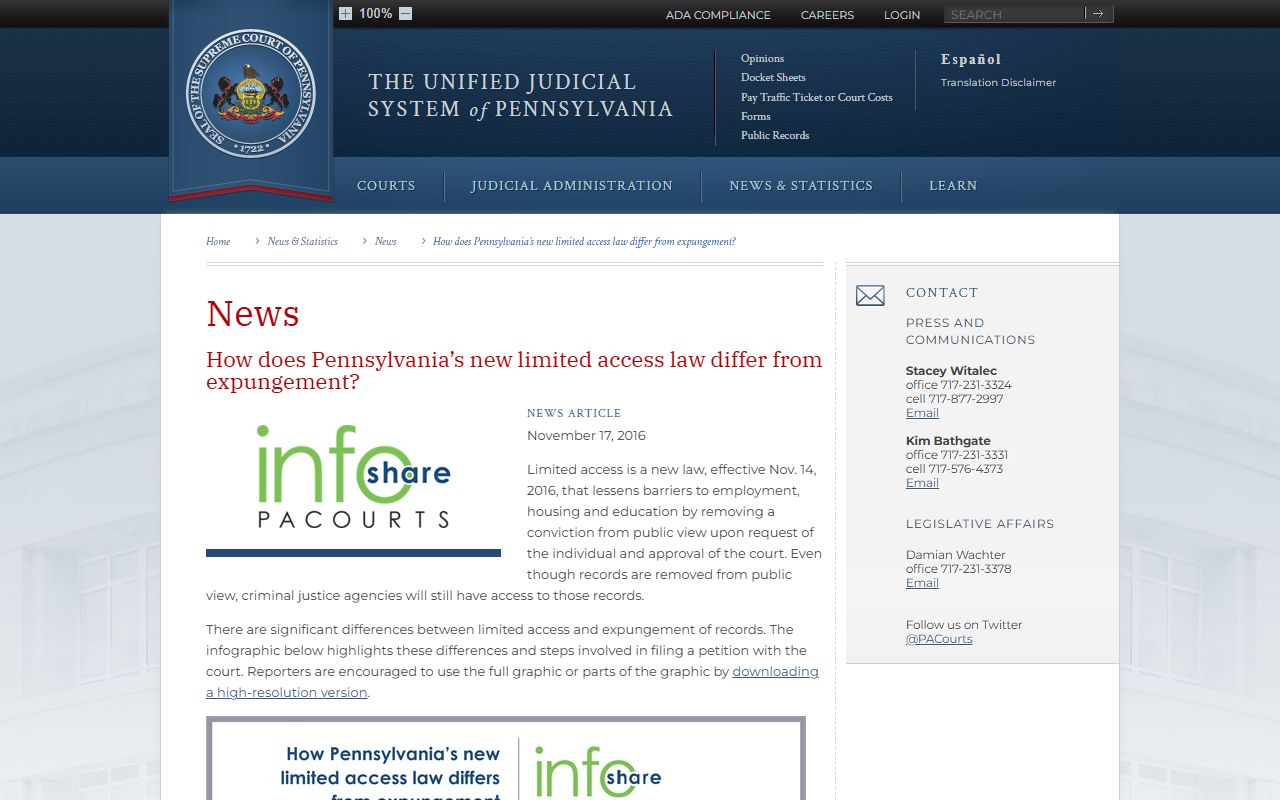
That distinction is critical when an older charge no longer appears in public search results but may still be available to courts or agencies.
Lebanon County Charge Codes
Charge rows in Lebanon County court records can show a statute, statute description, grade, offense date, originating sequence, and OTN. Grade helps identify the level of the charge, while the statute number ties the allegation to Pennsylvania law. The OTN is an offense tracking number used in Pennsylvania criminal records and can help match a charge across stages.
The District Attorney's Office is at 400 South 8th Street, Room 11, Lebanon, PA 17042. District Attorney Pier Hess Graf leads the office, and the DA page states the office handles more than 2,400 cases per year. The office also references ARD, DUI Court, Veterans Court, victim witness services, and Crimewatch. Those programs can affect docket outcomes, but the charge record itself must be read from the filed case.
Statewide Charge and History Checks
UJS Case Search warns that public docket sheets are not criminal-history background checks. The Criminal History Record Information Act notice referenced by UJS is tied to 18 Pa.C.S. section 9101 et seq., and employers can face liability for misuse. Use court dockets to understand case activity, but use the proper Pennsylvania criminal-history process when an official background record is required.
Important: A charge row is not a conviction, and a public docket is not an FCRA-ready background report.
Restricted Lebanon County Charge Records
Juvenile charge records, sealed cases, expunged records, limited-access records, victim information, confidential addresses, minor information, and protected identifiers may be withheld or redacted. Arrest or jail administrative records may also be limited for medical, security, classification, or investigative reasons. For a warrant tied to a missed appearance or unpaid costs, verify with the Sheriff, issuing court, Clerk of Courts, or Probation Collections rather than relying only on an online payment screen.